How Does Text-to-Speech Help Students? Benefits, Limits, and Best Uses
Students work with a wide range of written material, from textbooks and research papers to PDFs, online articles, study notes, and scanned documents. Text-to-speech, or TTS, gives them another way to access that information by converting written text into spoken audio. This can be useful when students want to listen while following along with the text, review longer reading assignments, hear unfamiliar words, proofread their own writing, or work with material that is difficult to read continuously on a screen. For scanned or image-based content, OCR can also make visible text available for speech when the TTS tool supports it.
However, text-to-speech is not automatically helpful in every situation. Some learning tasks require close visual attention, independent reading practice, or careful review of tables, formulas, citations, and other details that may not translate well into audio. The most effective use of TTS therefore depends on the student, the material, and the learning goal.
How Can Text-to-Speech Help Students?
Text-to-speech can support students in several ways, although the benefits are not equally strong for every learner or every task. Depending on how it is used, TTS may:
- Reduce the effort required to decode written text.
- Support reading comprehension for some learners.
- Help some students stay engaged with reading.
- Make proofreading and revision easier.
- Make study materials more flexible.
- Support pronunciation and listening practice.
- Improve access to written information.
The key is to match TTS to the learning objective rather than assume that listening is always better than reading.
1. Reduce Decoding Effort When Decoding Is Not the Goal
Reading requires students to recognize and decode written words before they can focus fully on meaning. For fluent readers, much of this process happens automatically, but students with significant decoding difficulties may need to devote considerably more effort to recognizing individual words.
TTS can reduce that demand by providing an auditory version of the written material. The CAST Universal Design for Learning Guidelines explain that limited decoding fluency can create barriers to accessing information and recommend options such as text-to-speech when decoding itself is not the instructional objective.
For example, if a student is reading a biology chapter to understand cellular respiration, difficulty decoding individual words may make it harder to access the underlying scientific concepts. TTS can provide another route to the same information, allowing more attention to be directed toward understanding the subject matter.
That distinction is important. If decoding is the skill being taught or assessed, having the text read aloud may work against the purpose of the activity. TTS is most useful when teachers and students clearly distinguish between learning to read and reading to learn.
2. Support Reading Comprehension for Some Learners
Text-to-speech may also support reading comprehension, particularly for some students with reading difficulties, but the effect is not universal. Research suggests that outcomes vary depending on the learner, the material, and how TTS is used.
A meta-analysis published in the Journal of Learning Disabilities examined text-to-speech and related read-aloud tools for students with reading disabilities. Across the included studies, researchers found a positive average effect on reading comprehension, while also reporting substantial variation between individual studies.
More recent research shows a similarly nuanced picture. A 2023 study published in Annals of Dyslexia found significantly higher comprehension scores in TTS conditions than during silent reading among children ages 8 to 12 with reading and language difficulties.
A 2026 eye-tracking study published in Reading and Writing found that the effects differed by learner profile. TTS improved comprehension among students with ADHD-related reading difficulties, while students with dyslexia completed the reading with less time and cognitive effort while maintaining similar comprehension. Typically developing readers did not show the same comprehension benefit.
Because that study was relatively small and involved Mandarin-speaking junior-high students in Taiwan, its findings should not be generalized to every student. Taken together, however, the research highlights an important point: the useful question is not simply whether TTS improves comprehension, but whether it helps a particular learner understand a particular type of text more effectively.
3. Help Some Students Stay Engaged With Reading
Text-to-speech can provide a more consistent reading pace, which may help some students stay engaged with longer passages. Students who frequently lose their place, reread the same sentences, or find their attention drifting may find it easier to follow the material when it is presented as audio.
A study published in the Journal of Computer Assisted Learning compared silent reading and TTS-supported reading among 20 students with dyslexia and 50 typically developing students. In the TTS condition, researchers observed better comprehension and less mind-wandering across the sample, while students with dyslexia were significantly more on task than during self-paced reading.
These findings suggest that TTS may help with attention in some reading situations, but they do not show that it automatically improves focus for every student. Engagement can depend on the learner, the material, playback speed, task difficulty, study environment, and how actively the student interacts with what they hear.
TTS is most useful when listening remains part of the learning activity. Following along with the text, taking notes, identifying key ideas, or answering questions can help keep the student engaged, whereas letting the audio play in the background while concentrating on another demanding activity is unlikely to make studying more effective.
4. Make Proofreading and Revision Easier
Students can also use text-to-speech to review their own writing. After reading the same essay or assignment several times, it can become easy to overlook problems because the writer already knows what a sentence is supposed to say.
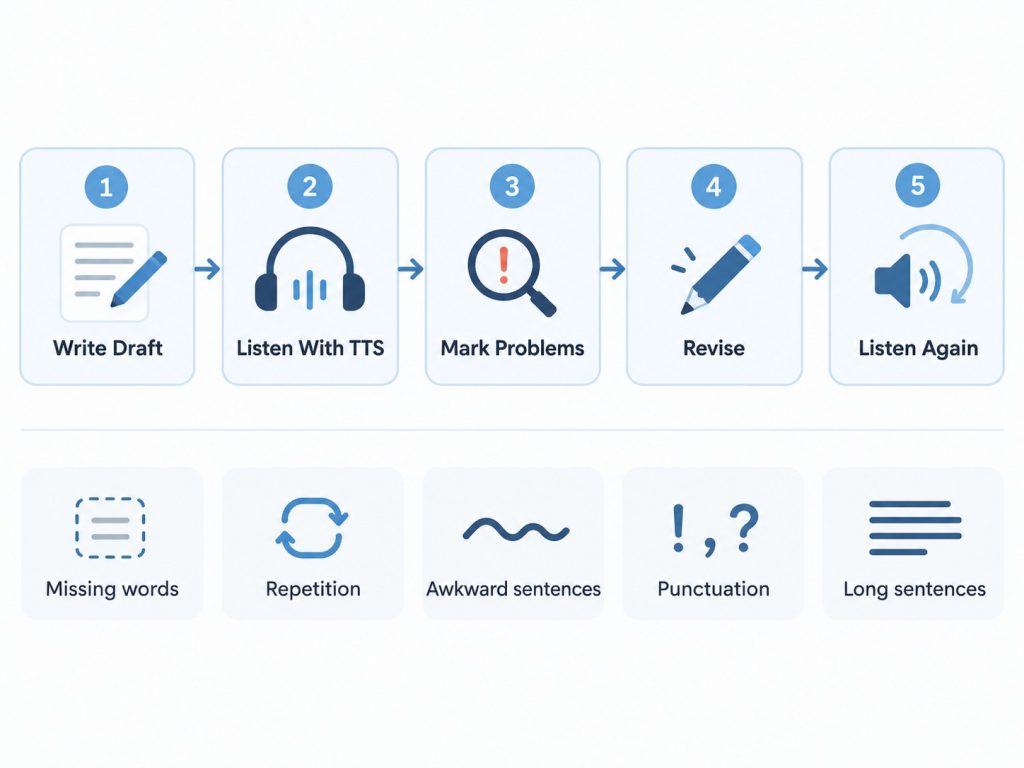
Hearing the draft aloud can make certain issues easier to notice, including:
- missing words
- repeated words or phrases
- awkward sentences
- unexpected pauses caused by punctuation
- overly long sentences
- wording that sounds unnatural
Edutopia describes using TTS to listen back to student writing as one practical approach to revision and literacy development. A simple workflow is to write the draft, listen to it, mark anything that sounds unclear, revise the text, and then listen again.
TTS does not replace grammar checking, teacher feedback, or careful editing. Instead, it gives students another way to evaluate how their writing sounds and identify areas that may need improvement.
5. Make Study Materials More Flexible
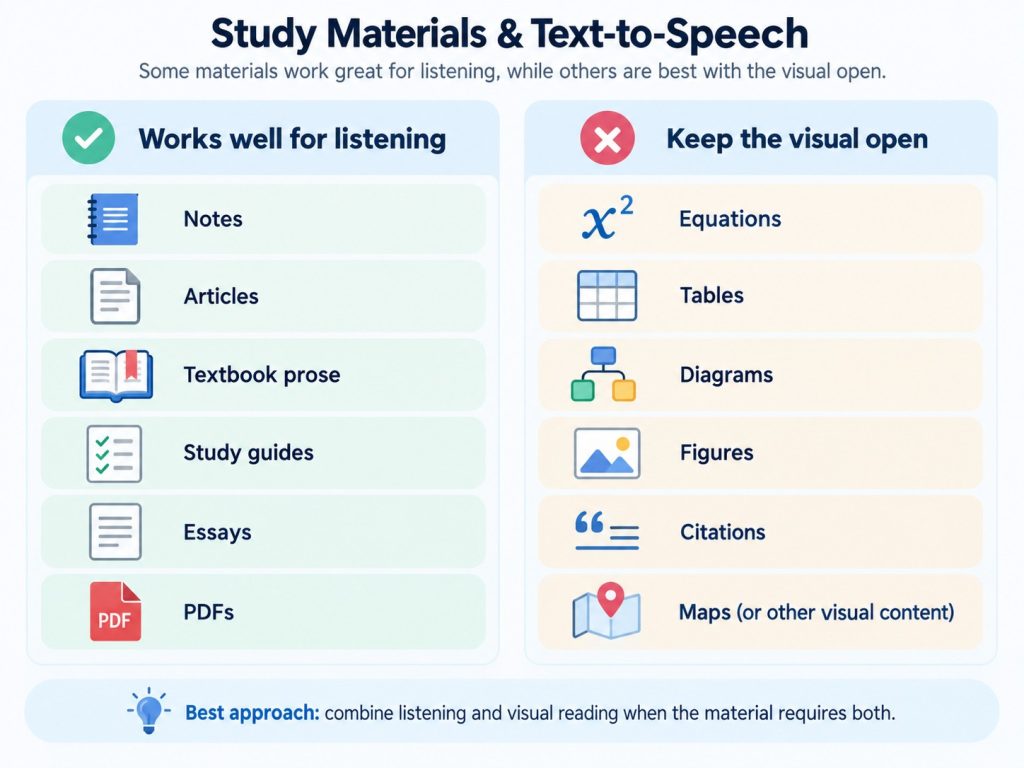
Text-to-speech gives students another way to review written study materials and can be useful with content such as:
- lecture notes
- academic articles
- textbook excerpts
- research webpages
- study guides
- assignment instructions
- essays
- digital handouts
- PDFs
This flexibility can be especially useful when students are reviewing material they have already studied. For example, a student might read a difficult research article carefully during an initial study session and later listen to selected sections to reinforce the main ideas, while another student may prefer listening and following the original text at the same time.
The best approach depends on the material. Prose-heavy content often works well for listening, while equations, tables, diagrams, citations, and other visually structured information usually require closer visual attention. TTS is therefore most useful as an additional study format rather than a universal replacement for visual reading.
6. Support Language Learning and Pronunciation Practice
Text-to-speech can give language learners a repeatable way to hear written words and sentences spoken aloud. Students can use it to:
- hear a spoken version of unfamiliar words
- listen to sentences before reading them aloud
- replay words and phrases
- compare written and spoken forms
- practice listening at different playback speeds
Research has also examined TTS as part of pronunciation training. For example, a 2025 study published in the Canadian Journal of Applied Linguistics involving Arabic-speaking ESL learners found improvements in aspects of phonological awareness across TTS-supported training conditions, with varied-voice training providing additional benefits for some pronunciation measures.
These findings do not mean that synthetic speech alone can teach a language. Conversation, feedback, vocabulary and grammar study, reading, speaking practice, and exposure to natural speech all remain important. TTS is better viewed as an additional resource that allows students to hear and repeat written language as part of a broader learning process.
7. Improve Access to Written Material
For some students, accessibility may be the most important benefit of text-to-speech. The CAST Universal Design for Learning Guidelines recommend providing multiple ways to perceive information and identify converting text into audio as one way to improve access to written content.
The U.S. Department of Education’s guidance on assistive technology also recognizes that text-to-speech may serve as assistive technology for some students with disabilities. Importantly, decisions about assistive technology should be based on the individual student’s needs rather than assuming that the same solution will work equally well for everyone.
For a student who has difficulty accessing conventional printed material, TTS may therefore be more than a study convenience. It can provide an auditory way to access written information in documents, webpages, PDFs, and other supported materials.
However, a general-purpose TTS tool should not be confused with a full screen reader or a complete accessibility solution. TTS can convert supported text into spoken audio, but it does not automatically fix accessibility problems in the original document or provide all the navigation and interaction features available in specialized assistive technology.
Which Students May Benefit From Text-to-Speech?
There is no single type of student who needs or benefits from TTS. A more useful approach is to identify the barrier the student is experiencing and consider whether listening provides a practical way to access or review the material.
| Student need | How TTS may help | Useful applications | Important limitation |
| Dyslexia or decoding difficulties | Provides spoken access to written material and can reduce the effort required to decode every word | Textbooks, articles, assignments, longer reading passages | Does not replace evidence-based reading instruction when decoding is the skill being taught |
| ADHD-related reading difficulties | May provide a more consistent reading pace and help some students stay engaged | Longer passages, study materials, structured reading sessions | Improved engagement does not automatically lead to better comprehension |
| Visual impairment | Provides auditory access to supported written content | Documents, webpages, PDFs, and study materials | A general TTS tool is not a complete screen reader or accessibility solution |
| English learners | Allows students to hear written words and sentences repeatedly | Vocabulary review, sentence practice, listening and pronunciation practice | TTS should supplement, not replace, broader language instruction and exposure to natural speech |
| Students without significant reading difficulties | Provides another format for reviewing and working with written information | Notes, proofreading, familiar material, longer documents | Audio may offer flexibility without providing an additional comprehension benefit |
The same student may also find TTS useful for one task but unnecessary for another. A student who benefits from listening to a long history chapter, for example, may still need to work visually with a statistics assignment containing equations, charts, and tables.
The decision should therefore be based on the student, the material, and the learning objective rather than on a diagnosis or student category alone.
Using TheSpeakr for Student Reading and Study Materials

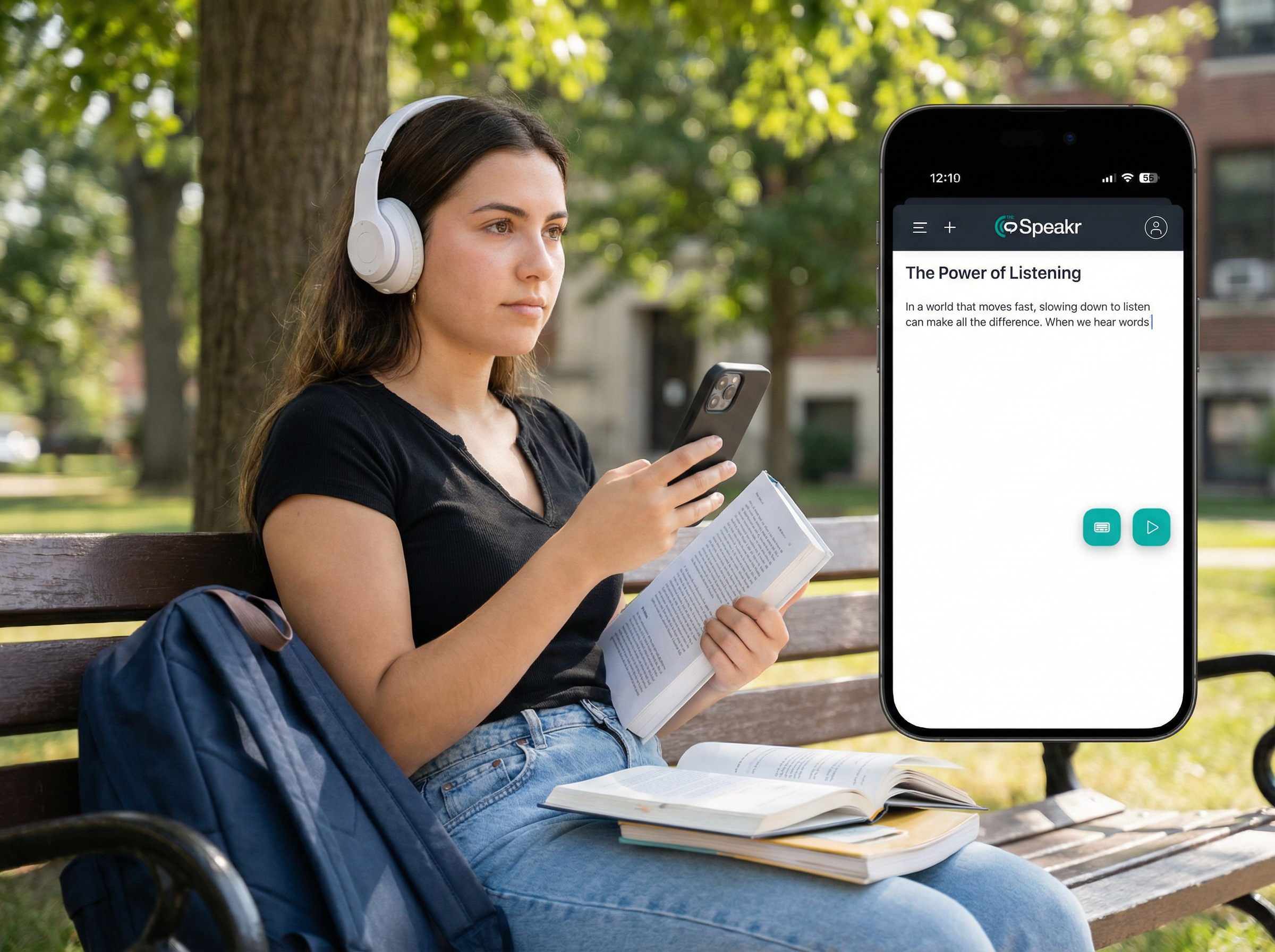
Once a student knows why they want to use TTS, a tool such as TheSpeakr can provide the practical workflow for turning study materials into audio. Students can type or paste text, provide a webpage URL, or upload supported files such as PDFs, Word documents, and plain-text files. TheSpeakr can also use OCR to detect text in photos, screenshots, and scanned PDFs.
The platform offers multiple voices in more than 40 languages and allows users to adjust playback speed. These features make it suitable for working with notes, articles, webpages, documents, PDFs, and image-based study materials.
Example: Listening to a Research Paper
A college student working through a research paper could:
- Upload the PDF to TheSpeakr.
- Listen to the beginning while comparing it with the original document.
- Choose a comfortable voice and playback speed.
- Keep the original PDF visible when following a difficult section.
- Pause when needed to take notes or review tables, figures, or citations.
- Increase the playback speed later when reviewing familiar material.
Complex PDF layouts can sometimes affect how text is extracted or presented in sequence, so comparing the audio with the original document is useful when reading order matters. Learn more about PDF text-to-speech with TheSpeakr
Using TheSpeakr With Scanned Materials
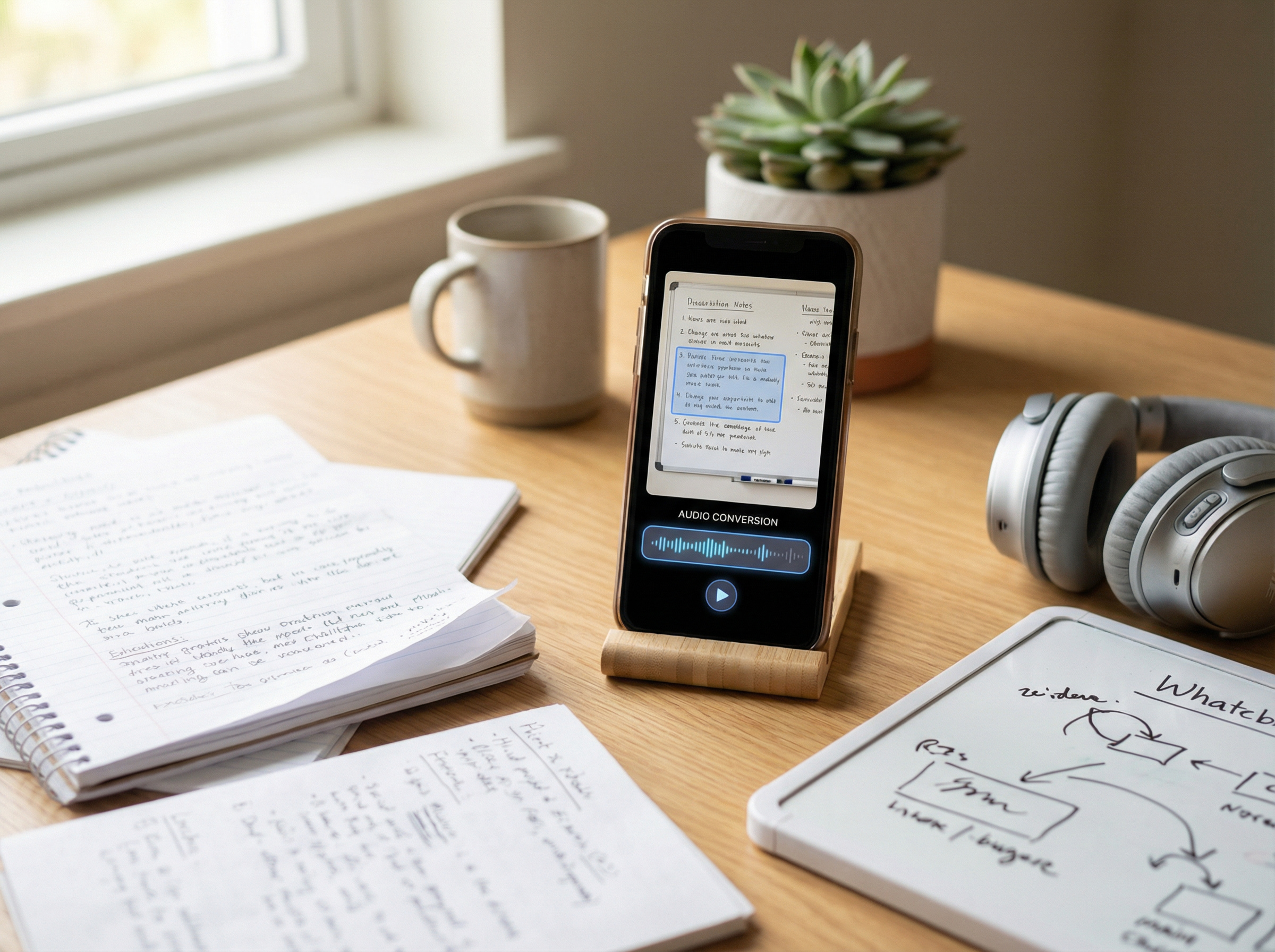
TheSpeakr can also process scanned PDFs, photos, and screenshots using OCR before converting the detected text into speech. This is useful when the original material contains images of text rather than normal machine-readable text.
OCR accuracy still depends on the source material. Blurry images, unusual layouts, handwriting, poor contrast, or incorrectly oriented pages can affect recognition, so students should compare important information with the original source when accuracy matters.
Using TheSpeakr for Proofreading
Students can also paste an essay or other written assignment into TheSpeakr and listen to it before submitting the final version. Hearing the draft aloud may make missing words, repeated phrases, awkward sentences, or punctuation-related pauses easier to notice.
After identifying a problem, the student can revise the original draft, update the text used for TTS, and listen again. TheSpeakr provides the speech output for this workflow, but it is not a grammar checker, essay editor, learning-management system, or full screen reader, and it does not guarantee better grades, comprehension, or learning outcomes.
Frequently Asked Questions
How does text-to-speech help students learn?
Text-to-speech can reduce the amount of effort some students spend decoding written words and provide another way to access study material. Research suggests that it can support comprehension for some students with reading difficulties. It can also be useful for proofreading, pronunciation practice, review, and accessibility, although the benefits vary by learner and task.
How does text-to-speech help students with dyslexia?
TTS can read words aloud so that a student does not have to rely entirely on decoding each word visually. This can make difficult material more accessible and, in some studies, has improved comprehension or reading efficiency. It should generally be considered a compensatory support rather than a replacement for instruction designed to develop reading skills.
Does text-to-speech help students focus?
For some students and tasks, TTS may provide useful external pacing and help maintain engagement with a passage. However, attention is influenced by many factors. Playing TTS in the background while concentrating on another demanding task should not be assumed to produce effective learning.
Can text-to-speech help English learners?
TTS can provide repeatable spoken models of words and sentences, making it useful for connecting written English with pronunciation. Students can listen, repeat phrases, and practice at different speeds. It should supplement rather than replace speaking practice, instructor feedback, listening to natural speakers, and other language-learning activities.