ElevenLabs Review 2026: Voice Testing, Model Breakdown, and Real Pricing
ElevenLabs is one of the strongest AI voice platforms currently available for text-to-speech, voice cloning, dubbing, and conversational voice agents. It combines high-quality neural voices with multilingual support, Studio production workflows, real-time generation, and developer APIs, making it better suited for creators and businesses than simple reading apps.
The platform’s biggest strength is voice quality. ElevenLabs consistently ranks near the top of AI voice naturalness benchmarks, while its V3 model pushes emotional expression further than most mainstream competitors. The free plan is also unusually generous for the category, offering 10,000 monthly credits with full MP3 export access, while paid plans start at roughly $6/month annually.
That said, ElevenLabs is less ideal for users who only need lightweight listening or fully predictable flat-rate pricing. The platform uses a credit-based system where costs change depending on the model you use, which makes the real pricing harder to estimate until you understand the differences between V2, V3, Flash, and Turbo.
What Is ElevenLabs?
ElevenLabs is an AI voice platform founded in 2022 by Mati Staniszewski and Piotr Dąbkowski. While many text-to-speech tools focus on a single use case, ElevenLabs positions itself as a broader AI audio ecosystem that combines neural text-to-speech, voice cloning, dubbing, conversational AI agents, and developer APIs inside one platform.
In practice, users can generate realistic speech from text, clone voices from audio samples, dub videos into multiple languages, convert PDFs and documents into audio, build real-time voice agents, generate sound effects, and stream low-latency speech through APIs. That wider product scope is what separates ElevenLabs from competitors that specialize more narrowly in reading apps, business voiceovers, or developer infrastructure.
CEO Mati Staniszewski summarized the company’s ambition in a TIME profile by saying, “We want to be the voice of the technology around us.” That direction explains why ElevenLabs has expanded beyond traditional text-to-speech into Studio narration workflows, conversational AI, APIs, and mobile listening experiences rather than remaining just a simple TTS generator.
How We Evaluated ElevenLabs
This review is based on official ElevenLabs documentation, pricing pages, hands-on testing, and direct comparisons with competing TTS platforms. We tested the Free and Starter plans across multiple workflows, including Studio PDF narration, multilingual generation, voice cloning, and model comparisons between V2, V3, Flash, and Turbo.
Testing included desktop and mobile workflows, PDF and DOCX imports, raw text prompts, web URL narration, Studio exports, and both short- and long-form audio generation. We also tested English, Spanish, and Japanese output to evaluate multilingual consistency, along with Creative and Agents separately to better understand how the platform is structured for different types of users.
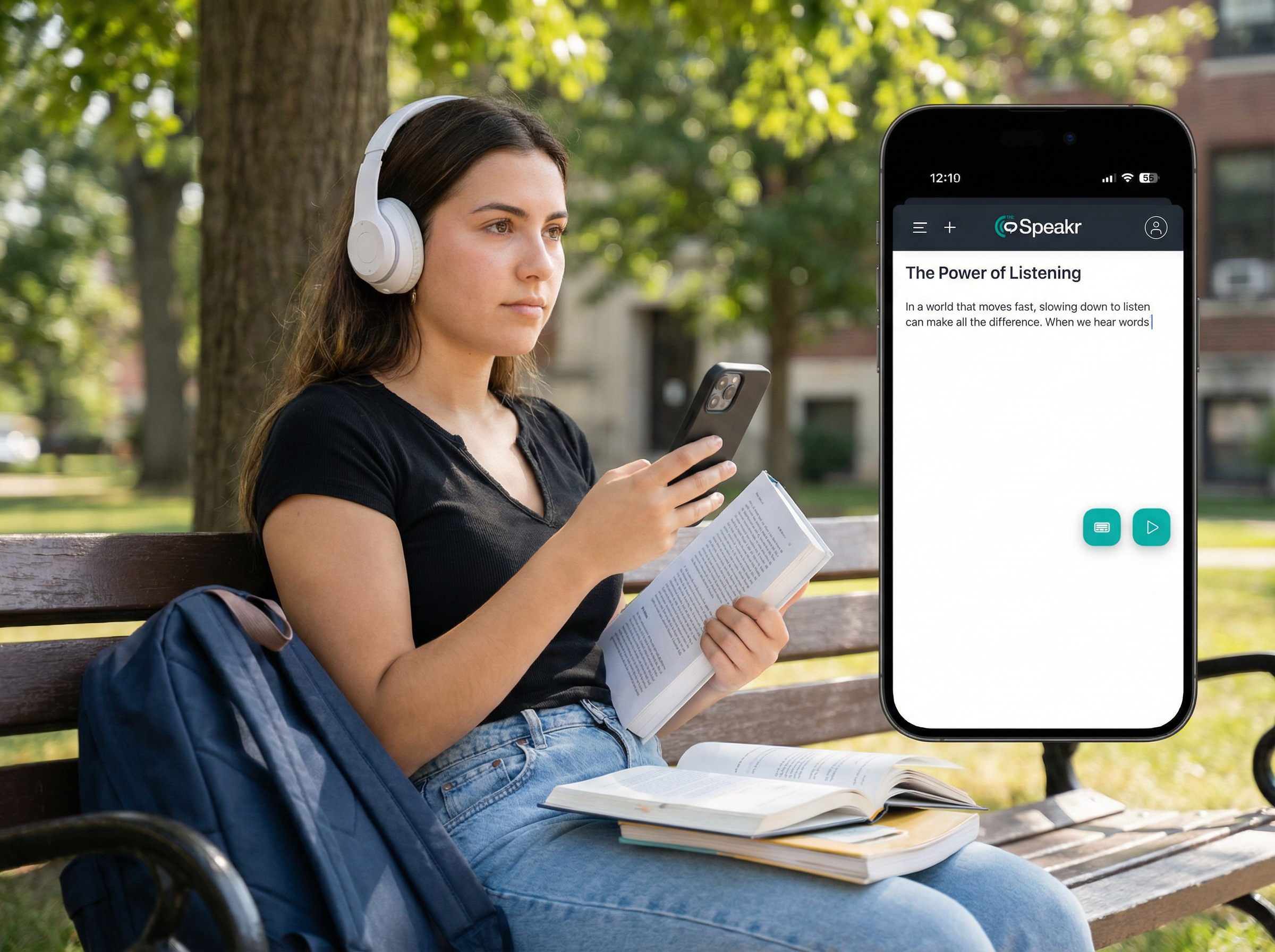
Part of this review also focused on usability and platform clarity, since ElevenLabs’ Creative-versus-Agents ecosystem is one of the most confusing areas for first-time users. For transparency, The Speakr operates in the broader TTS category, so this review includes analysis from inside the AI voice industry rather than from a neutral consumer publication.
Creative vs Agents: Two Sides of ElevenLabs
One of the most confusing parts of ElevenLabs is that the platform now operates as two connected ecosystems: Creative and Agents. Most users researching AI voice generation will spend nearly all their time inside Creative, while Agents is designed more for developers building real-time conversational systems.
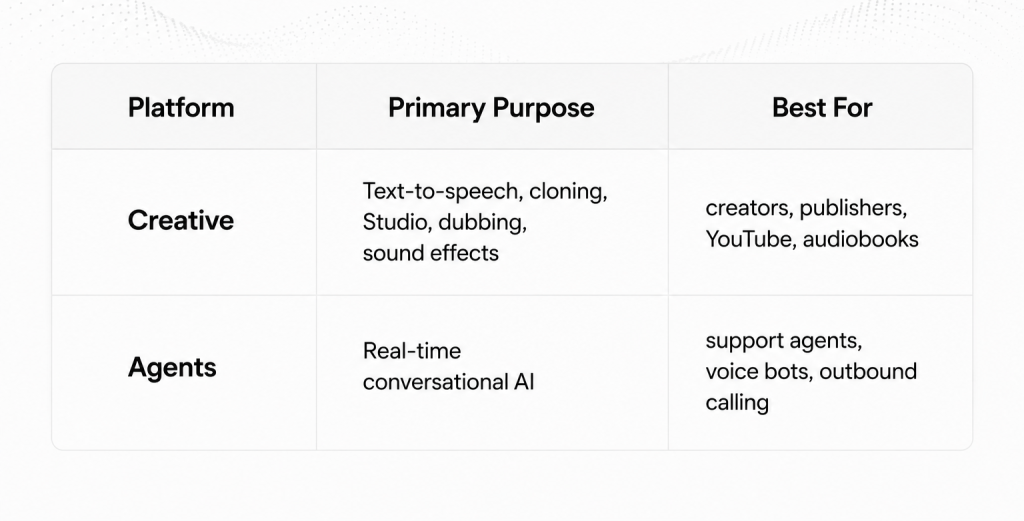
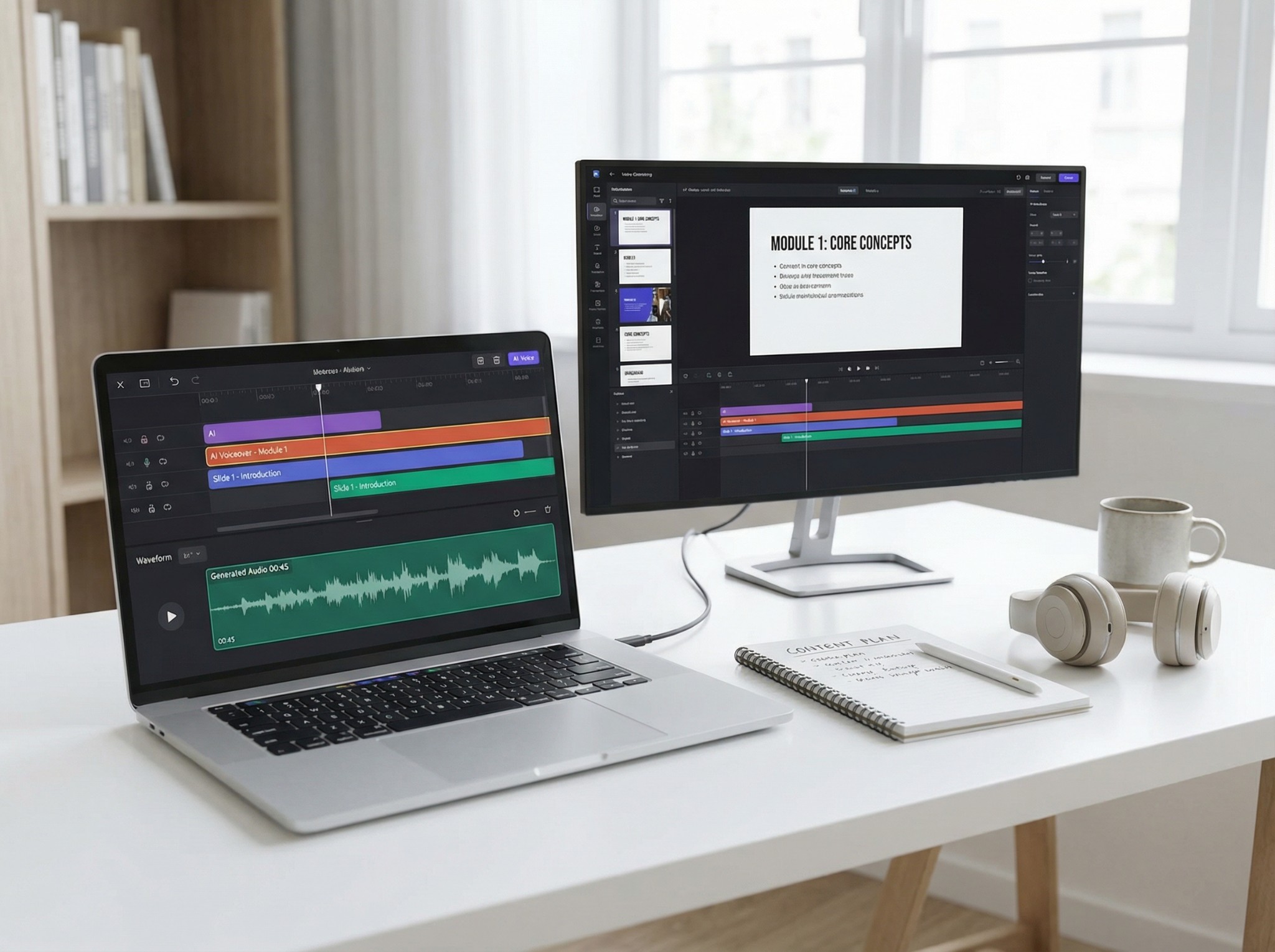
The Creative platform is the production-focused side of ElevenLabs. It includes text-to-speech, Studio workflows, voice cloning, dubbing, sound effects, voice changing, and experimental music-generation tools. This is where creators build narration workflows, generate YouTube voiceovers, create audiobooks, or produce multilingual audio content.
Studio is especially important because it supports long-form production workflows like PDF narration, automatic chapter splitting, multi-speaker projects, and podcast-style audio generation. Compared with simpler TTS tools, Creative feels much closer to a lightweight AI audio production suite.
Agents, by contrast, focuses on conversational AI rather than narration. It supports real-time voice conversations, streaming, outbound calling, integrations, low-latency interaction, and tool-based actions. In practice, this makes Agents more comparable to conversational voice infrastructure than to a traditional text-to-speech product.
The distinction is relatively simple once understood: if your goal is YouTube narration, audiobook production, dubbing, or voice generation, you will likely use Creative. If you are building AI customer support systems, phone agents, or real-time conversational experiences, Agents is the more relevant platform. For most readers researching ElevenLabs, Creative will remain the primary product.
ElevenLabs Pricing
ElevenLabs Pricing in 2026
Pricing is one of the most misunderstood parts of ElevenLabs because many reviews focus only on the headline monthly plans without explaining how the credit system actually works. Unlike flat-rate subscription tools, ElevenLabs uses a usage-based model where costs change depending on which generation model you use.
As of 2026, the public pricing structure includes:
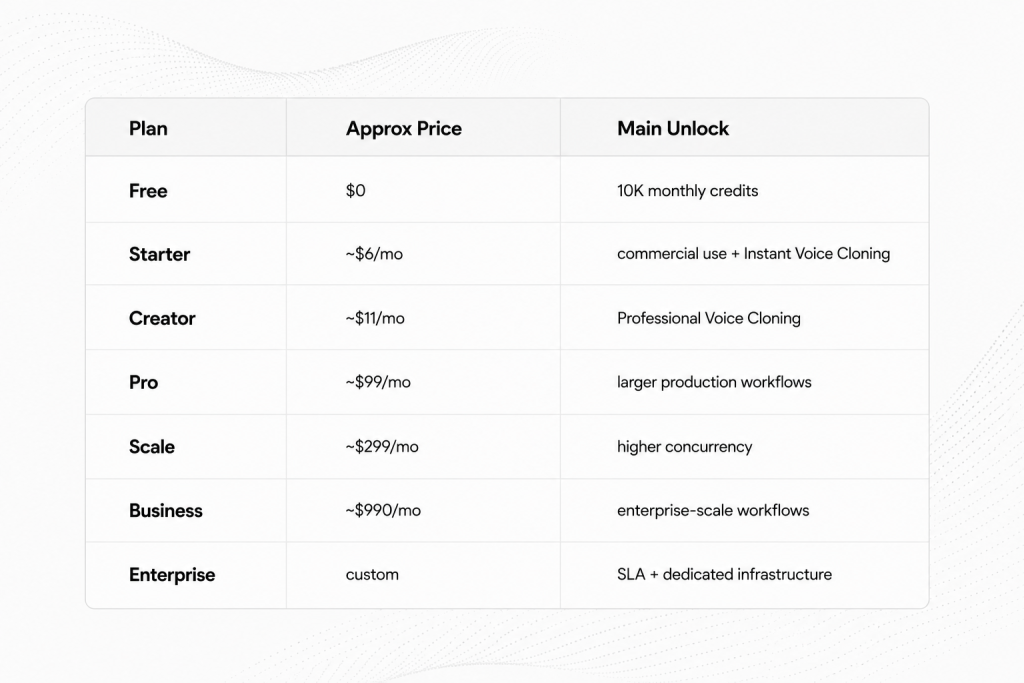
The free plan is significantly more usable than most competing free tiers. It includes 10,000 monthly credits, MP3 downloads, access to multiple models, limited Studio functionality, and three active voice slots from the voice library. The biggest limitations are concurrency and production scale rather than basic usability, which means casual creators can realistically test the platform without immediately upgrading.
The more important detail is that different models consume credits differently. V2 and V3 generally cost more per character, while Turbo and Flash are optimized for faster and more cost-efficient generation. As a result, the real value of a plan depends less on the subscription tier itself and more on which models and workflows you use most often.
Credit Math by Model
The most important part of ElevenLabs pricing is not the subscription tier itself, but how different models consume credits. V2 and V3 generally cost around 1 credit per character, while Turbo and Flash are designed to be more cost-efficient at roughly 0.5 credits per character. In practice, that means the Free plan’s 10,000 monthly credits translate to roughly 10,000 characters on V3, but closer to 20,000 characters on Flash or Turbo.
That difference dramatically changes the platform’s real value depending on your workflow. Users focused on premium narration or expressive storytelling will usually spend credits faster, while high-volume production workflows become significantly cheaper on faster models.
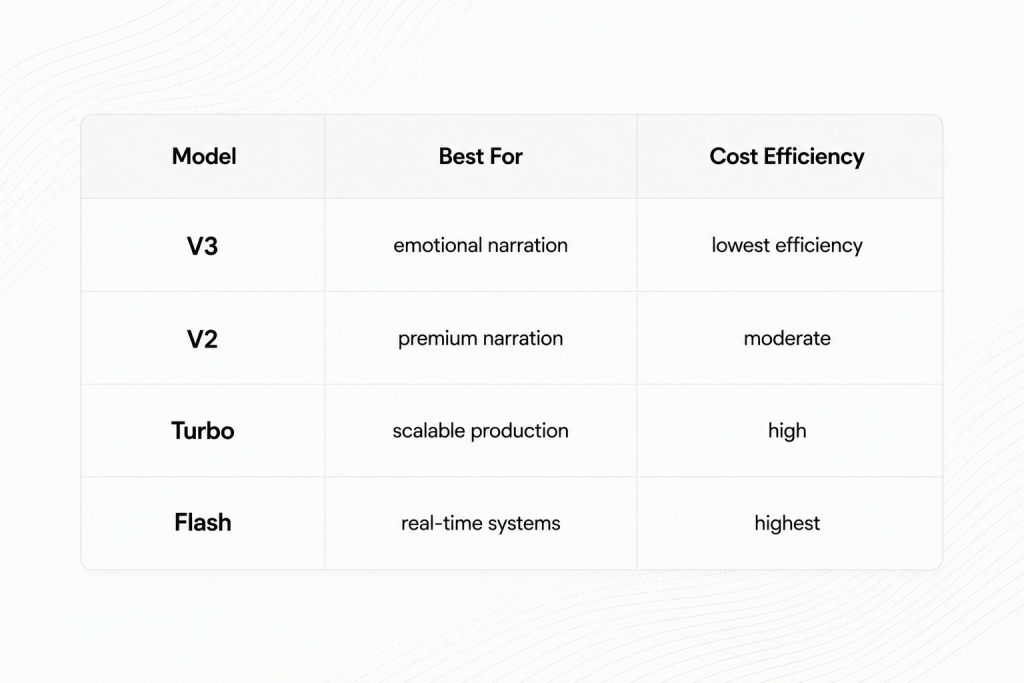
In practical terms, V2 and V3 make the most sense for audiobooks, podcasts, and high-quality narration. Turbo is better suited for large YouTube batches or scalable content production, while Flash is optimized for conversational AI, streaming systems, and low-latency voice interaction.
The Model Lineup Explained
V2 remains the safest default for polished narration. It performs especially well for audiobooks, podcasts, YouTube voiceovers, and long-form speech because the voices sound stable and pronunciation errors are relatively uncommon. For many creators, V2 still offers the best balance between quality and consistency.
V3 Alpha pushes emotional expression further. It handles dramatic delivery, dynamic pacing, character-style narration, and emotional variation more naturally than most mainstream TTS systems. The tradeoff is predictability — V3 can sometimes feel less stable than V2, particularly in polished commercial workflows where consistency matters more than expressiveness.
Turbo exists mainly for scale. It sacrifices some vocal nuance in exchange for lower costs, faster generation, and higher throughput, making it a stronger fit for bulk production workflows where efficiency matters more than maximum realism.
Flash prioritizes latency above everything else. Official documentation references latency around 75ms in certain workflows, which makes Flash particularly useful for conversational agents, real-time voice applications, streaming systems, and AI assistants where response speed is critical.
Voice Quality and Multilingual Performance
Voice quality remains the main reason ElevenLabs dominates so much discussion around AI audio. Compared with most mainstream competitors, the platform generally sounds smoother, more emotionally flexible, and noticeably less robotic, particularly in longer narration workflows. Its biggest strengths are prosody, pacing, emotional transitions, and overall conversational naturalness rather than just raw pronunciation accuracy.
That advantage becomes even more noticeable in multilingual generation. Many TTS systems technically support dozens of languages but begin sounding unnatural once they move outside English. ElevenLabs performs better than average across languages like Spanish, Japanese, French, German, and Portuguese, where pacing and intonation tend to remain relatively natural. Arabic and tonal-language handling can still vary depending on the selected voice and model, but overall multilingual consistency is stronger than what most consumer-focused TTS platforms currently offer.
Voice Cloning: Real Expectations
Voice cloning quality depends far more on sample quality and sample length than most marketing demos suggest. While many platforms advertise fast cloning from very short recordings, the realism of the final output changes significantly depending on how much clean training audio is available.
Instant Voice Cloning is designed for speed and convenience. Official guidance suggests that roughly 1–2 minutes of clean audio is enough to produce usable results, and in practice the generated voice is usually recognizable and functional for lightweight narration or experimentation. However, shorter samples often compress emotional range and can introduce inconsistencies in pacing, tone, or pronunciation.
Professional Voice Cloning uses much larger datasets and delivers noticeably better results. Official recommendations reference roughly 30–180 minutes of training audio for higher-quality cloning, and the difference is substantial. Longer datasets produce voices that sound more stable, preserve tone more accurately, handle emotional delivery more naturally, and reduce common artifacts that appear in short-sample cloning.
This means cloning quality depends less on the platform itself and more on the amount and quality of source audio available. Even the strongest AI voice systems perform significantly better when trained on longer, cleaner recordings.
ElevenLabs Studio: PDF-to-Audio Workflow
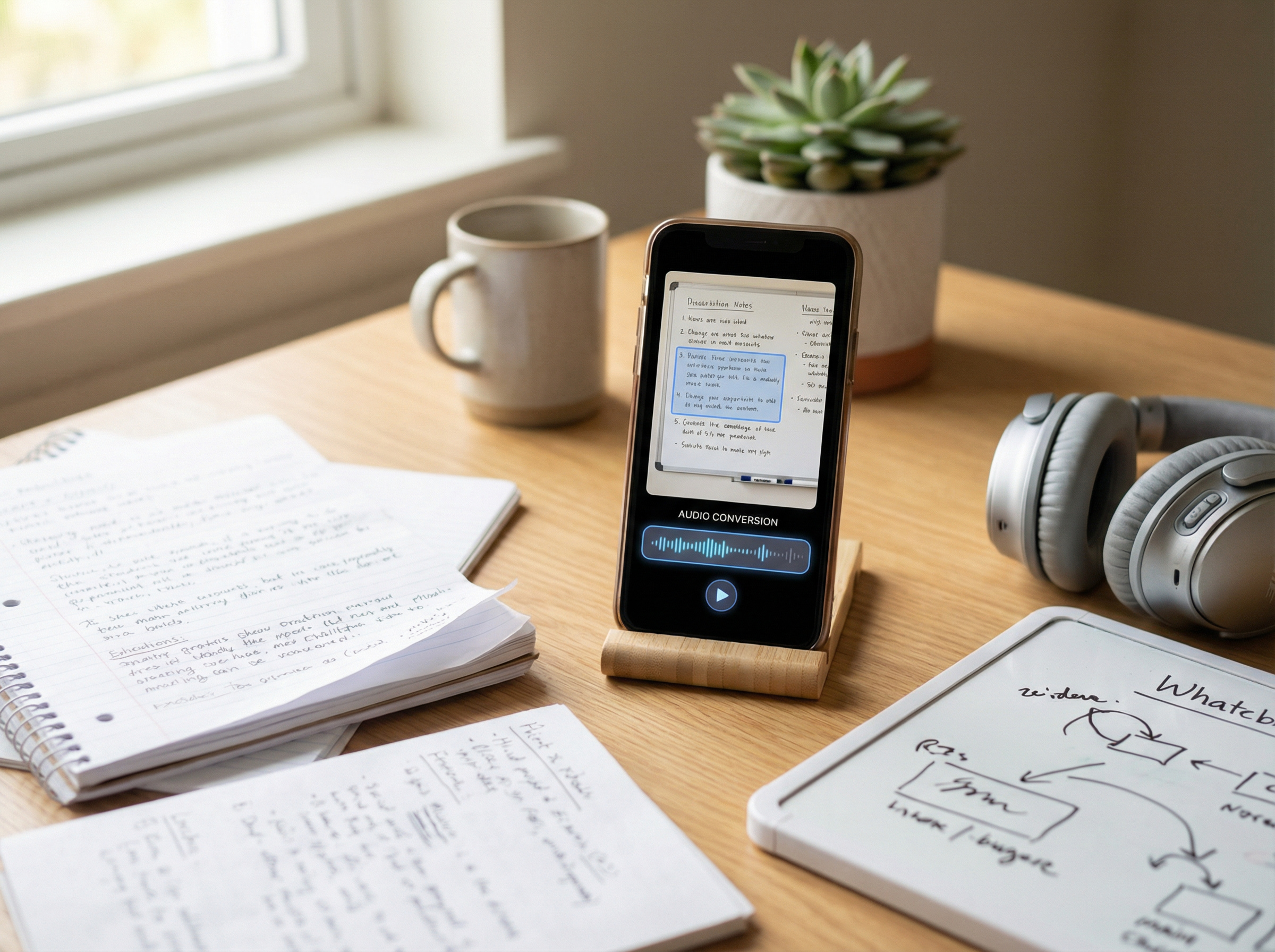
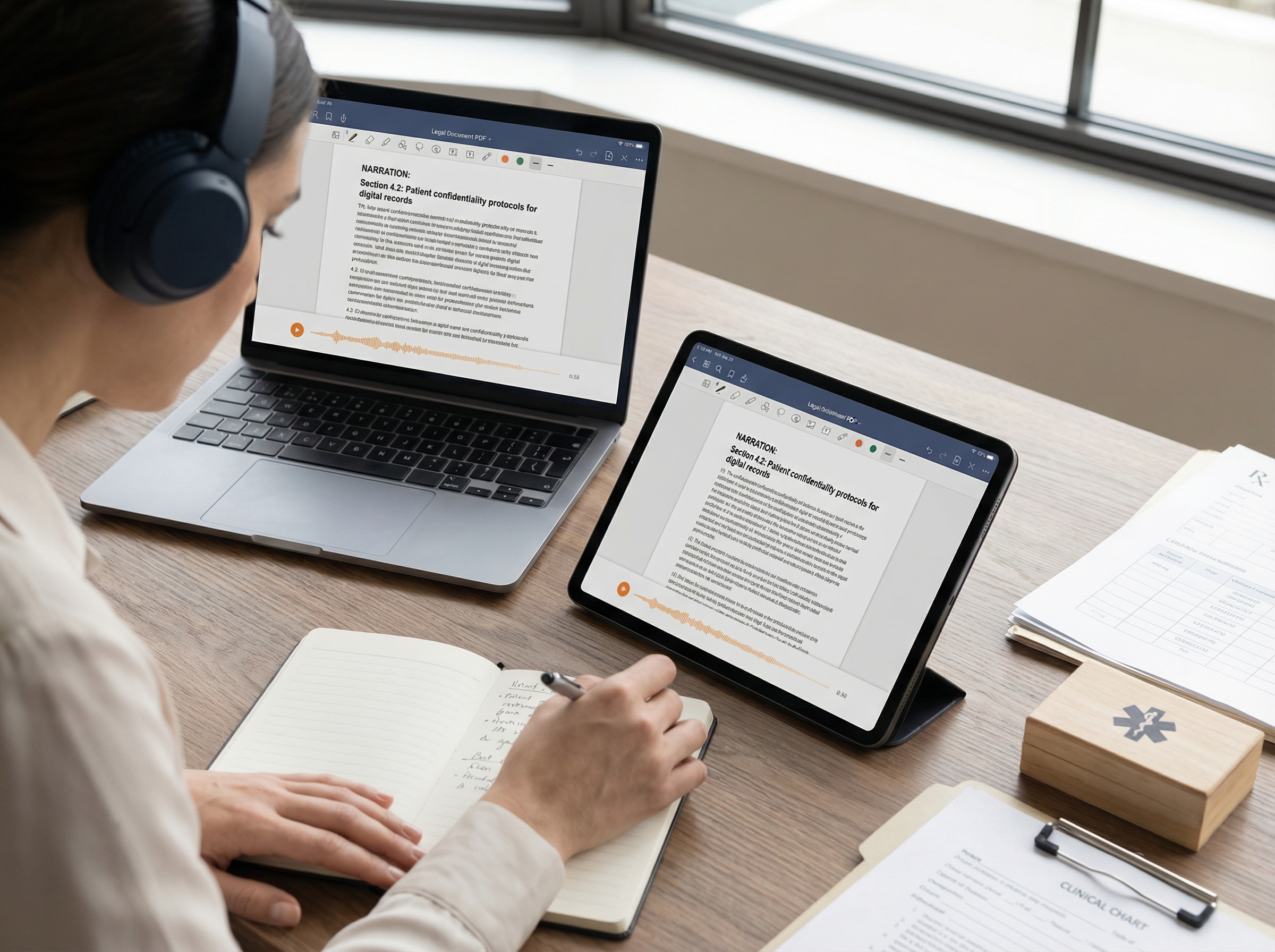
Studio is one of ElevenLabs’ strongest differentiators because it turns the platform into something much closer to an AI audiobook production suite than a simple voice generator. Users can upload PDFs, import DOCX files, assign multiple speakers, generate long-form narration, and export structured audio projects directly from the browser.
Supported formats currently include PDF, EPUB, TXT, HTML, DOCX, XML, and FDX, making Studio flexible enough for everything from ebooks and scripts to articles and production documents. For creators working with long-form content, this workflow is significantly more advanced than the basic copy-and-paste generation found in many competing TTS tools.
The biggest advantage is chapter handling. Studio can automatically detect document structure, separate chapters, maintain project organization, and export sections individually rather than forcing users into one continuous audio file. That dramatically improves usability for audiobook production, podcast-style narration, and large document workflows where structure matters as much as voice quality itself.
Dubbing, Sound Effects, and Extra Tools
Beyond text-to-speech and voice cloning, ElevenLabs has expanded into a broader set of AI audio tools aimed at creators and production workflows. These features are not the platform’s primary selling point, but they help position ElevenLabs as a more complete audio ecosystem rather than a standalone TTS generator.
The dubbing system allows users to translate and re-voice content into multiple languages, making it particularly useful for YouTube localization, online courses, training material, and multilingual publishing workflows. Compared with traditional dubbing pipelines, the process is significantly faster and more accessible for smaller creators.
ElevenLabs also includes AI-generated sound effects, capable of producing ambient sounds, cinematic effects, and environmental audio directly from prompts. While dedicated audio-production tools still offer deeper control, the feature works well inside lightweight creator workflows where speed matters more than advanced sound design.
Another addition is Voice Changer, which allows one speaker’s recording to be transformed into a different voice style. In practice, this sits somewhere between voice cloning and stylistic voice modification, expanding the platform beyond traditional narration use cases.
API and Developer Experience
Developers are one of the main reasons ElevenLabs grew so quickly beyond traditional text-to-speech. The platform supports REST APIs, streaming, WebSockets, and official Python and JavaScript SDKs, making it easy to integrate AI voice generation into games, assistants, SaaS products, AI agents, and phone systems.
Compared with older cloud TTS providers, ElevenLabs feels more modern and creator-oriented, combining developer infrastructure with high-quality voices, cloning, and real-time audio generation inside one ecosystem.
Safety, Deepfakes, and Trust
Like every advanced voice AI platform, ElevenLabs faces obvious deepfake and impersonation risks. The company publicly discusses safeguards such as voice verification, policy enforcement, AI speech detection, and provenance tools designed to reduce misuse.
Its AI Speech Classifier reportedly achieves around 99% precision and 80% recall for unmodified ElevenLabs-generated audio, while higher-tier cloning workflows also use voice-captcha verification systems. Even so, no current voice platform fully solves the broader risks surrounding deepfakes and synthetic speech misuse.
ElevenLabs Pros and Cons
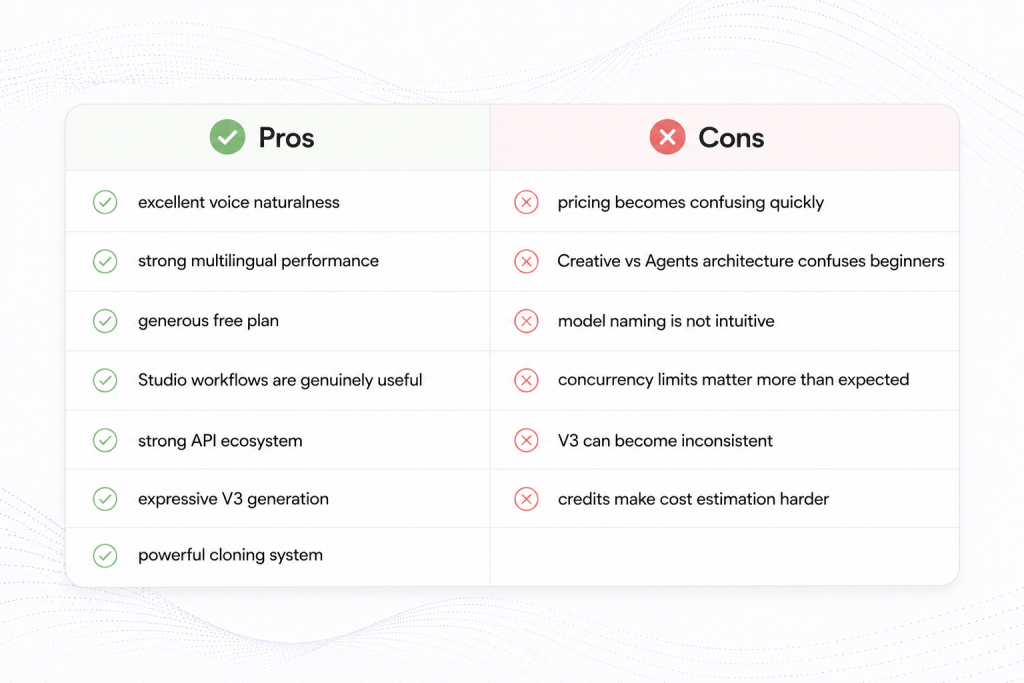
Overall, ElevenLabs delivers some of the strongest voice quality and creator-focused tooling currently available, but its pricing structure and platform complexity create a steeper learning curve than simpler text-to-speech tools.
Best Alternatives
The best ElevenLabs alternative depends on your workflow. Speechify is stronger for accessibility, passive reading, and cross-device listening, while ElevenLabs is better for narration, voice generation, and production workflows. Murf AI is more business-focused, particularly for team collaboration, training content, and presentation voiceovers, whereas ElevenLabs generally delivers stronger voice quality and cloning realism. Cartesia prioritizes ultra-low-latency APIs and real-time conversational infrastructure, making it a strong option for developers building voice agents and interactive applications.
For readers comparing multiple platforms, our guide to the best text-to-speech tools in 2026 provides a broader comparison of ElevenLabs, Speechify, Murf AI, NaturalReader, and other leading AI voice solutions. The right choice ultimately depends on whether your priority is voice quality, accessibility, business narration, developer tools, or content production at scale.
Is ElevenLabs Worth It?
ElevenLabs is one of the strongest AI voice platforms currently available, especially for creators, publishers, and developers who need realistic speech generation, multilingual narration, voice cloning, and production-grade audio workflows. While simpler tools may work better for casual listening or accessibility-focused reading, ElevenLabs stands out as one of the most complete ecosystems for AI voice production and
FAQ
- Is ElevenLabs free?
Yes. ElevenLabs offers a permanent free plan with 10,000 credits per month and MP3 downloads.
- What is the difference between V2 and V3?
V2 is more stable and production-ready. V3 is more expressive and emotional but less predictable.
- Can ElevenLabs read PDFs?
Yes. Studio supports PDF uploads with chapter detection and audio export.
- Is ElevenLabs good for voice cloning?
Yes, especially with longer training samples. Professional cloning performs significantly better than instant cloning.
- What languages does ElevenLabs support?
Official documentation references support for 70+ languages.
- Is ElevenLabs better than Speechify?
They solve different problems. ElevenLabs is production-focused while Speechify is reading-focused.
- Does ElevenLabs have an API?
Yes. It supports REST APIs, streaming, WebSockets, and SDKs.
- Is ElevenLabs safe?
The platform includes voice verification, moderation systems, and AI speech detection tools, although deepfake risks still exist across the industry.