Assisitive Technology for Dyslexia: How Text-to-Speech Improves Reading and Comprehension

For people with dyslexia, the challenge of reading is not about intelligence or effort — it is about the cognitive cost of decoding. Every word requires conscious processing that fluent readers do automatically, leaving less mental capacity for actually understanding what is on the page. Among assistive technologies for dyslexia, text-to-speech addresses this most directly, and the research behind it is more specific and more compelling than most people realize. You can see how this works in practice — and try it yourself — in this text-to-speech for dyslexia case study.
This article covers what the evidence actually says about TTS for dyslexic readers, and how it applies across the three contexts where reading demands are highest: school, work, and daily life.
How TTS Helps Across Different Contexts
Students: getting through the reading load
Reading is a major difficulty that people with dyslexia face in secondary school and higher education institutions. There are chapters to read in textbooks, research articles to go through, assignments on literature, and lecture materials that build up. Many students with dyslexia fall behind not because they lack the ability to understand the material, but because the time and energy required to decode it at scale exceeds what is available.
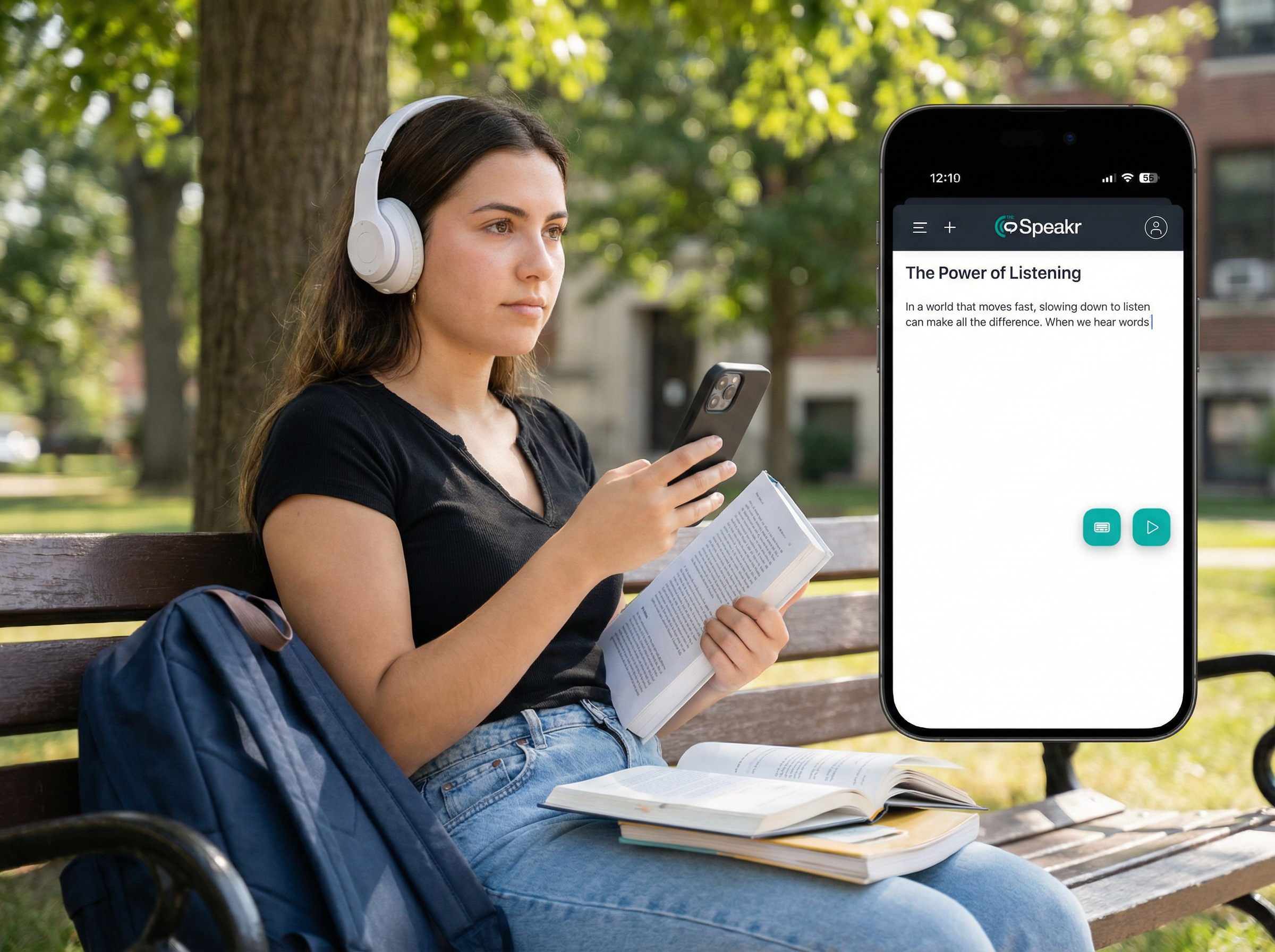
TTS addresses this at the production level. A student who listens to a history chapter while reading along moves through it faster and remembers more — because the brain is taking it in two ways at once. Variable listening speeds come into play when they slow down to understand complex technical explanations, speed up on things that are already known to them, or replay confusing sentences instead of rereading them.
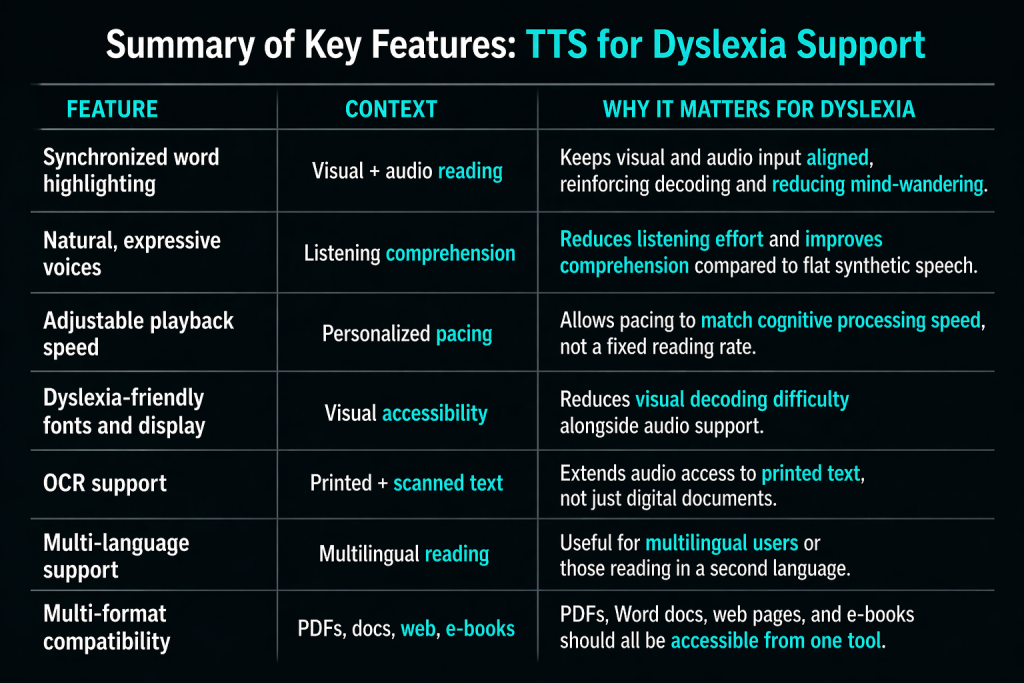
Dyslexia-friendly text settings — enlarged fonts, adjusted spacing, typefaces like OpenDyslexic — work alongside TTS rather than separately from it. The visual presentation reduces decoding difficulty for the words the reader is following; the audio removes it for the words being processed in real time. The combination is more effective than either intervention alone.
Professionals: keeping up with document volume
Workplace reading demands do not ease with age or experience. Most professionals deal with a steady stream of contracts, reports, emails, and compliance documents. For those with dyslexia, working through that same pile costs significantly more — in time, energy, and mental effort.
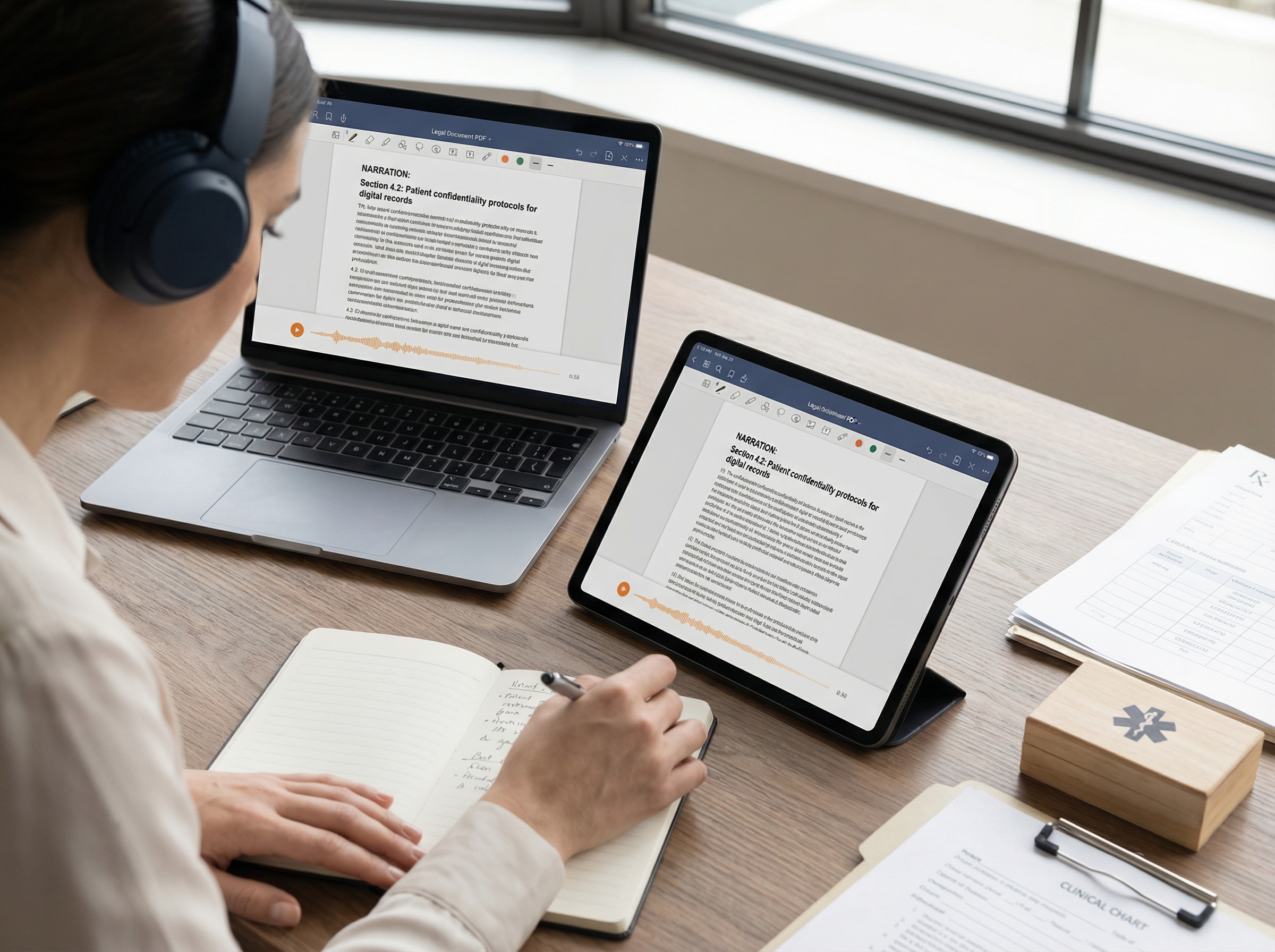
TTS changes the logistics of document review. A lengthy report no longer requires multiple tiring reading sessions. Listening gets it done in one sitting. A commute, a lunch break, or a routine task becomes productive reading time. Hearing content rather than decoding it also improves recall. The auditory channel reinforces what the visual channel takes in. That double input produces stronger memory traces of the material.
For professionals who work across languages, TTS with multi-language support adds a further dimension. Listening to a document in a second language while reading it is often more accessible than reading it silently, because the pronunciation support reduces the additional decoding layer that non-native scripts introduce.
Daily life: reading without the friction
The reading demands of everyday life — news articles, emails, instructions, menus, forms — are easy to underestimate for people without dyslexia. For those with it, these routine encounters with text carry the same decoding overhead as any other reading task, just distributed across a wider range of contexts.
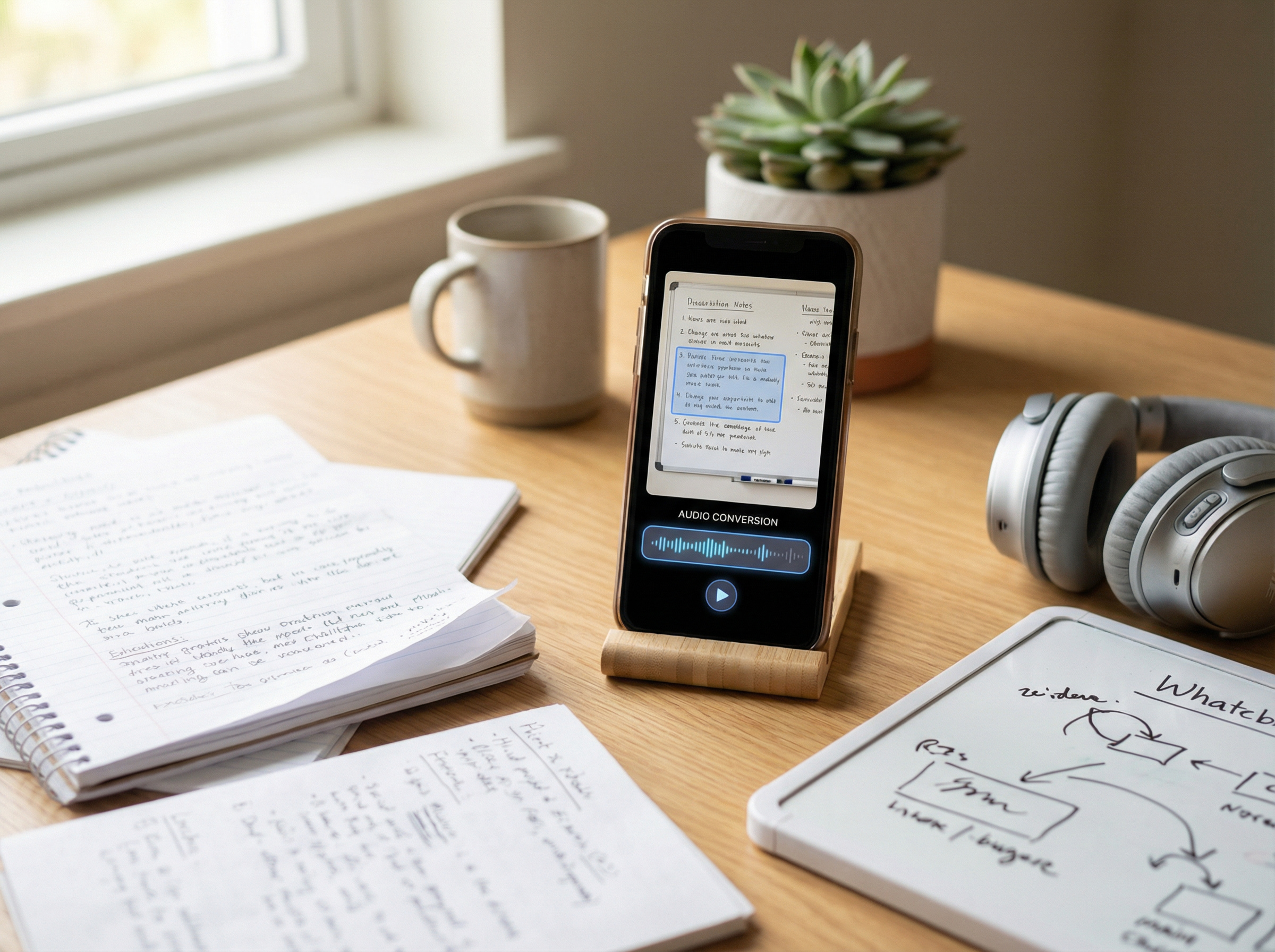
TTS tools with OCR functionality extend audio access beyond digital text to physical environments. A smartphone camera can read a printed menu, sign, or document out loud in seconds — a small thing for most people, but a genuinely useful one for someone with dyslexia moving through daily life.
The psychological effect of this accumulated ease is worth noting. Research on TTS use reports that when decoding pressure is removed, dyslexic readers engage with more text overall — not just the text they feel obligated to read. Reading for information and reading for pleasure both increase when the act of reading is no longer exhausting. Over time, that increased exposure supports vocabulary development and sight-word recognition in ways that carry back into unaided reading.
What the Research Shows About Text-to-Speech for Dyslexia
Dyslexia is primarily a phonological processing difficulty. The effort of converting written symbols into sounds — decoding — consumes working memory that would otherwise be available for comprehension. This is why many people with dyslexia understand spoken content perfectly well but struggle with the same material in written form. The words are not the obstacle; the visual decoding process is.
TTS removes that obstacle by handling decoding automatically. The reader hears the words while seeing them on the page, which shifts the cognitive load from decoding to understanding. A meta-analysis of TTS approaches found consistent comprehension improvements for students with reading disabilities. Some studies put the gain at around 24% for children with dyslexia — specifically when audio and text highlighting were synchronized, so the eye and ear were following the same word at the same time.
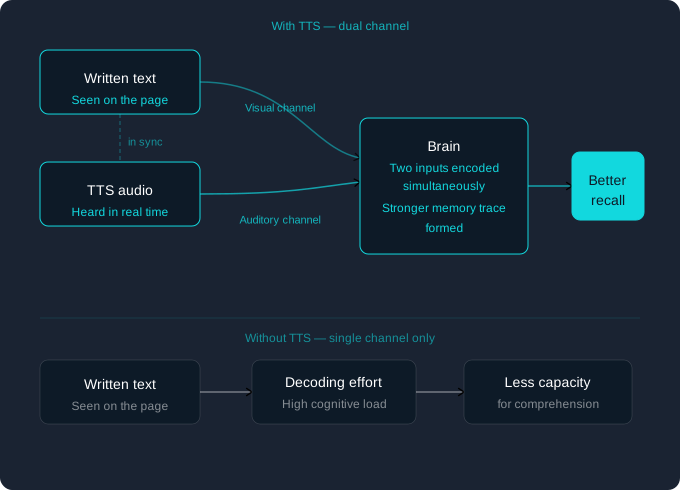
The synchronization matters. Hearing a word while seeing it highlighted at the same time is more than a convenience — it gives the brain two routes into the same information at once, which strengthens both recognition and understanding. Research grounded in Mayer’s multimedia learning theory and Paivio’s Dual Coding Theory consistently supports this: two synchronized channels produce stronger encoding than either alone.
Cognitive load and reading fatigue
One finding comes up repeatedly across TTS research: people find reading less mentally exhausting when they use it. Jafarian & Kramer (2025), published in Computers and Education: AI, the study ran a randomized controlled trial with 108 university students. Audio learning modules significantly reduced the cognitive effort of processing dense written text. Students with ADHD symptoms showed the largest gains. They also share with dyslexic readers a heightened vulnerability to cognitive overload. Both engagement and academic performance improved the most for that group.”
The practical consequence of lower cognitive load is that readers can sustain engagement for longer. Many people with dyslexia describe reaching a point of exhaustion after extended reading sessions — not because the material is too difficult, but because the physical act of reading drains their working memory before they have finished. TTS extends that threshold by offloading the decoding work.
Voice quality and its effect on comprehension
Not all TTS is equally effective. Dylman et al. (2025) demonstrated that voice expressiveness directly affects comprehension outcomes — children who heard passages narrated with natural intonation and prosody answered significantly more comprehension questions correctly than those who heard flat, monotone delivery. Voice quality is not just a matter of preference. When a voice sounds unnatural, the listener spends energy interpreting how something is said — energy that should be going toward understanding what is being said.
This is why modern neural TTS produces better outcomes than older synthetic voices. Human-like intonation, correct pronunciation, and natural pacing all make a difference. For dyslexic readers especially, a voice that sounds natural reduces friction. Attention stays on the content instead of on decoding the speech.
What to Look for in a TTS Tool for Dyslexia
Not every TTS tool is designed with dyslexic readers in mind. The features that matter most are not just voice quality, but the combination of capabilities that address the specific challenges of dyslexic reading:
The Bottom Line
The research case for TTS for dyslexia is solid. It reduces decoding load and improves comprehension. It also extends how long readers can engage without fatigue. TTS does not change how dyslexia works. It changes the conditions under which reading happens. The most effective use pairs it with synchronized highlighting and a natural voice. Add dyslexia-friendly display settings and the gap between understanding and access largely disappears.